
Native Languages Center
Language Documentation Workshop
Module 2:
Documentation and Data Management

- Module 2 Progress87.5%
Elements of a Strong Language Documentation Plan
We've talked about data management planning, but you most likely also need a Data Management Plan in order to pursue external funding for your project. This is a document describing your approach to safe storage and appropriate access. In this last section, we will walk through the requirements of a strong Data Management Plan.
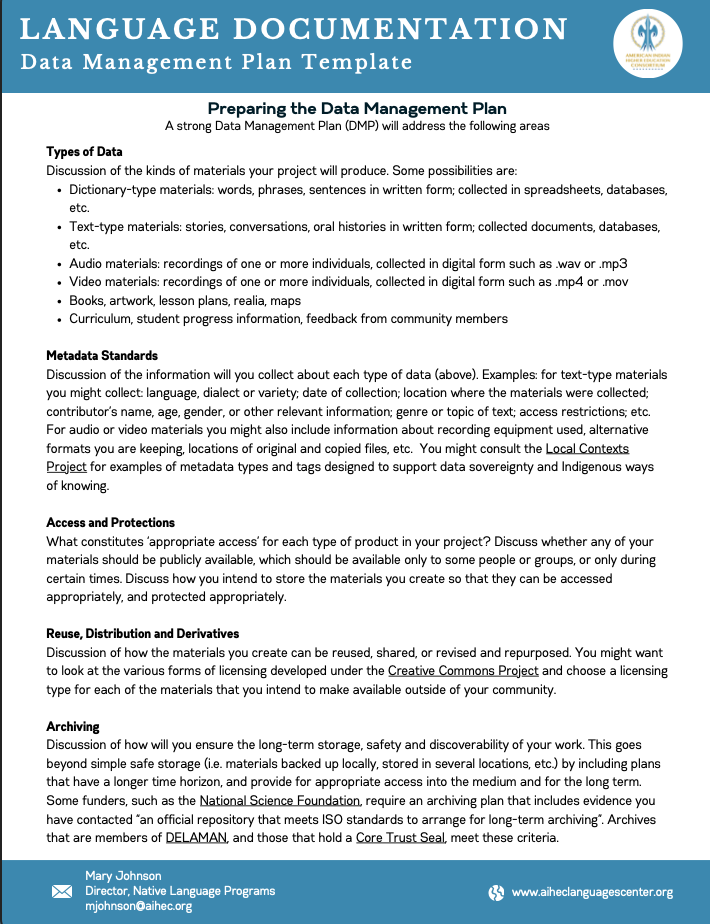
Essentially, the elements needed in a strong data management plan include:
Types of Data
This is a discussion of the kinds of materials your project will produce. It details what data will be recorded or collected and/or if your project will produce new materials from the data collected such as dictionary-type materials, classroom resources, etc.
Metadata Standards
This is the information you will collect about each type of data (above). Refer to section 2 of this module for reference. This is the descriptive pieces of information you will include about each type of data collected.
Access & Protections
This section is a description of the access authorization and protections you will have in place for the materials collected.
Re-use, Distribution & Derivatives
This section will be a discussion of how the materials created from your project will be reused, shared, revised or repurposed.
Archiving
Lastly, there should be some discussion of how you will ensure the long-term storage, safety, and discoverability of the materials. This goes beyond simple safe storage by including plans that have a longer time horizon, and provide for appropriate access into the medium and for the long term.
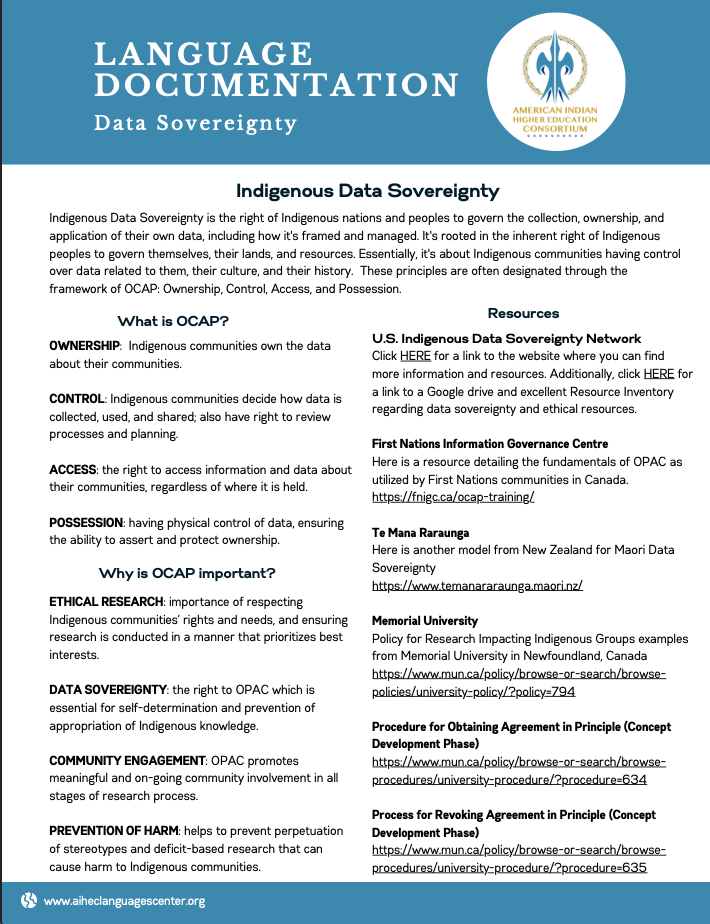
Refer to the handout Data Management Plan template for a quick reference and resources as you prepare your plan. The handout includes helpful links to outside resources. Additionally, you can contact the AIHEC Language Initiative for examples of successful Data Management Plans. The handout on Indigenous Data Sovereignty provides additional information, resources, and examples of how some tribal communities have addressed data sovereignty.
Resources
- Module 2 Progress100%